
The greenest energy
is the energy that is
never used at all
Ten centimetres of polyurethane hold heat like three and a half metres of brick. Everything else on this page follows the same logic — use less, both in our plant and on your building.
Ten centimetres against three and a half metres
Polyurethane is the reference. Move over a block — the circle says how thick that material would have to be for the same thermal protection.
Worked out from thermal conductivity (λ, W/mK): Polyurethane 0.022 · Polystyrene 0.037 · Mineral wool 0.041 · Timber 0.130 · Dry concrete 0.350 · Brick 0.800
The saving starts the day after installation
A panel is paid for once, but the building is heated and cooled every year. That is why most of the environmental effect arises not in our plant but over the life of the building.
A lower bill, in winter and in summer
Thermal protection does not only work against the cold. The same panel keeps the cool inside in summer, so the air conditioning runs for less time. The saving does not show on the bill for building, but on every bill after it.
More usable space
A wall ten centimetres thick leaves far more net floor area on the same plot than a brick wall with insulation added. On halls with a large perimeter that comes to tens of square metres.
A lighter structure
A panel weighs 10–28 kg/m². Lighter cladding means a slimmer load-bearing structure and less foundation — that is, less steel and concrete per building, before a single panel is fitted.
Less driving to site
One lorry of panels clads an area that would take several trailers of brick, block and wool. Every journey that does not happen is fuel that has not been burned.
We ask the same of ourselves
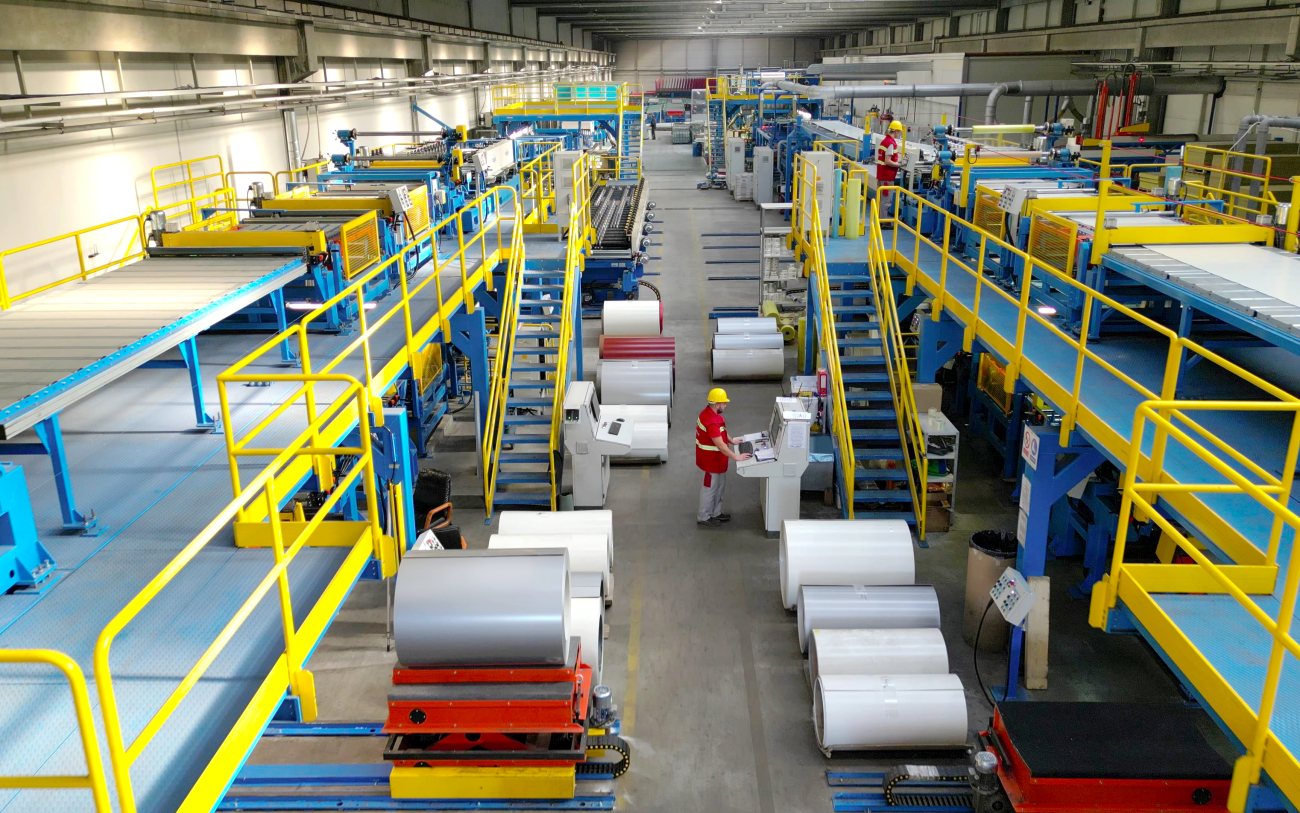
It is easy to sell insulation and waste electricity in your own hall. Three things at the plant in Hrasnica are there so that does not happen.
Electricity from our own roof
The roof of the production hall is the largest free surface we have, so solar panels stand on it. Part of the electricity the lines consume is generated a few metres above them — with no transmission, no losses on the way and no bill.
Not one conventional bulb
The lighting in the hall burns across three shifts, so the difference between an ordinary and an LED bulb is a serious item. Every plant is LED only — less consumption for the same, measurably better lighting of the workplace.
Filters before the chimney
The furnace in the plant runs with a filter system that holds back soot and harmful matter, so no toxic smoke goes into the air over Hrasnica. That is not a marketing decision but the condition under which we want to operate in an inhabited place.
Steel goes back, it is not thrown away
The facings of the panel are steel sheet — a material that is recycled without losing quality and goes back into the melt as a raw material in its own right. Offcuts from the lines do not end up in landfill but in that same loop.
Waste and emissions in production are managed to ISO 14001, alongside ISO 9001 for quality and ISO 45001 for occupational safety. That means kept records and an outside audit, not a statement of good intentions.
- ISO 14001Environmental management — waste and emissions in production.
- ISO 9001Quality management system, in place since 2005.
- ISO 45001Occupational health and safety across all plants.
How much would your building save?
Send us the dimensions and the use of the building — we come back with a proposed panel thickness and type, with the heat transfer coefficient for each option.